Author Archives: Geoff Boyce

Unknown's avatar

About Geoff Boyce

Creating and supporting opportunities for human flourishing. geoff@geoffboyce.com

Oasis Hospitality Cycle

WhiteboardOasis Hospitality CycleOasis as an Inter-agency

At our last weekly Oasis team meeting I was hoping to find out how Oasis might be introduced to newcomers beyond naming hospitality as making space – our prime motif.

“Oasis is a listening-post!” suggested Maureen Howland. She was making connections with a Mental Health First Aid course she had just attended.

So we took to the whiteboard.

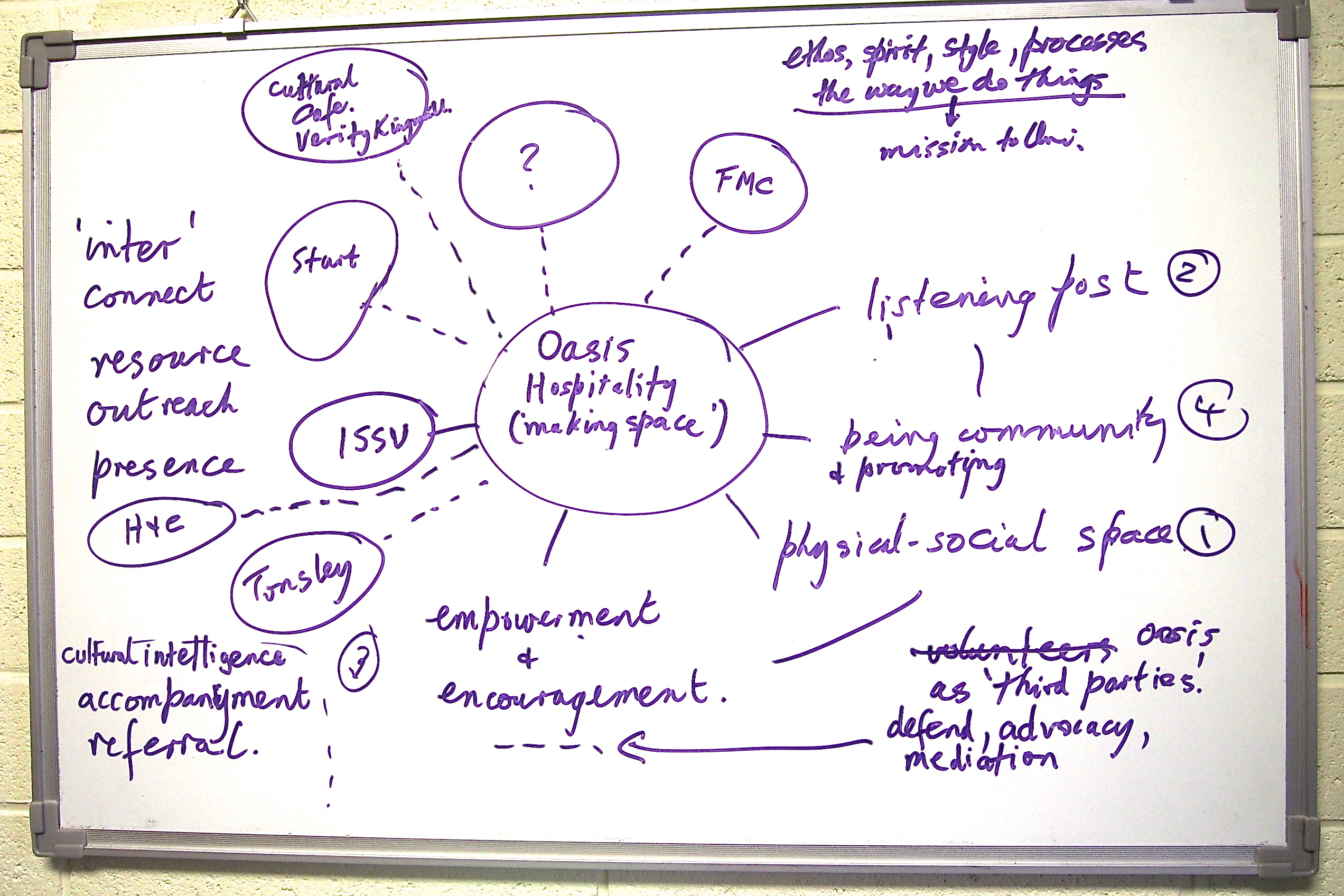
An hour, and bowls of soup, with bread, cheese and tomatoes later, we had come up with a picture of what we reckon we do at Oasis. Charles thought that the various elements form a cycle, so we put the elements into some kind of order.

When we had exhausted our ideas and discussion, Charles took a photo of the whiteboard, emailed it to me and I created the simplified design above – The Hospitality Cycle. The leftover thoughts seemed to me to describe aspects of the intent of Oasis, so I gathered them into another diagram – ‘Oasis as an Inter-agency’.

In this post I would like to discuss what lies behind these categories.

If radical hospitality, understood as making space, is at the heart of Oasis then we begin with the creation of physical and social space – Oasis as a place in which students feel at home, a place one enjoys being in, a place of warmth and friendship, and where the kettle is always on for a free cup of tea or coffee. It’s an inviting place where we make contact – meeting others as well as having the opportunity to make contact with our inner selves.

For the Oasis team, the next step is listening – holding on to our own opinions to make emotional and intellectual space for the other to articulate their thoughts, their feelings, their opinions. That’s not easy when we think we can easily see what could be done to help a painful situation. But rather than giving advice, we continue the listening to allow the other to go further or deeper in their verbal thinking and to begin to see a picture emerging in which they might be able to find a way through.

Of course, such listening is not just confined to trouble and pain. More often than not, those who come through the front door of Oasis want to share a joyous occasion. But one thing is for sure, everyone has something they’d love to say, if only they could find a respectful, safe and supportive place to say it! As Nouwen says, “We will never believe that we have anything to give unless there is someone able to receive”.

This listening is hopefully encouraging to the other – whether it be as solutions to problems become apparent or ideas for celebrating achievements emerge.  The actions that begin to frame in their minds as a result of their verbalisation continue to be encouraged through supportive listening.

We want them to know that they are not alone. Whether they are able to access other sources of support or not, the bottom line is that we will support them as they move forward in their plan of action.

‘Yes, we can help you launch that book; yes, we will be at your graduation; yes, I will be thinking of you- let me know how you get on; yes, if you like, I could introduce you to…’

And if there are issues beyond our competence, if a person needs more intensive support, we identify sources of such intervention and support and ensure they make the connection.

It might also mean that we offer to stand with a person as their advocate, or to stand between persons as mediators as well as accompany a person to an appointment.

But whatever the result of the listening and the encouragement and any action that arises, we accompany the person. This is no mean commitment – accompaniment is likely to be a sustained process of remembrance and effort in keeping contact, while such contact is called for. But in a world short on friendship, remembrance is a gift Oasis may offer.

The act of remembrance that is at the heart of accompaniment creates a sense of diasporic community. So perhaps it is not surprising that those who experience this kind of hospitality want to keep connected with Oasis in some way. Some even indicate that they want to take their experience of hospitality and offer it to others. They become members of the Oasis team or, if they are leaving Flinders, become Oasis ambassadors. Oasis enacts and models the practice of hospitality and by it’s very existence, promotes it.

This may take us back to the beginning of the cycle, as new contacts are made, attracted by the hospitality of Oasis.

When these contacts are outside the realm of Oasis, the process of hospitality may lead to partnerships or collaborations with other agencies. Oasis can act as a hospitable go-between or facilitator. It can share its experiences of the hospitality process with others and enable others to achieve their own goals.

The Faith Friendly Charter, for example, is a resource that emerged from Oasis and reflects its values; and Oasis team members may be called upon to assist others who want to implement it.

For example, the concept of faith friendliness and the Charter have encouraged Woodville High School to pioneer a multifaith approach to chaplaincy within their school and I continue to accompany them on their quest.

A parallel example of this is enacted by the MoTiv team at Delft Technical University, who, among other roles, act as film producers. The role of a film producer enables someone else’s script to come to life. So they act as producers on behalf of departments or students of the university, value adding to the university.

For example, a documentary of a final year engineering student engaged in his final project becomes a source of discussion among the Engineering staff – the challenges such a project poses for students beyond the field of engineering itself. And it becomes a source for discussion among students – coping with failure, resilience, imagination and the creative process.

These are the kind of partnerships and collaborations that Oasis could make as we ask the question ” what do you need of us at Oasis?”

So now we stand open for comment about the model that is emerging. It suggests to me ways forward for identifying who comprises the Oasis team and what training needs we may have as a learning community.

Sheffield Day Conference, July 8, 2013

P1020401

In the photo: on my left, Christopher Chester CA, Chief Executive, South Yorkshire Workplace Chaplaincy, who was my host and organised and chaired the conference, Rev Debbie Hodge, Chief Officer Multi Faith Group for Healthcare Chaplaincy in the National Health Service and Andrew Cropley, Executive Director for Strategic Planning and Business Development at The Sheffield College, which provided the venue.

The theme of the conference was “Multifaith Chaplaincy in the UK Public Sector”. It was attended by chaplains working in various settings and religious leaders and advisors in Further Education.

Sheffield is a pleasant city, and the only one in the UK that bears a Trademark – no-one can use the word “Sheffield” without permission. Because it was here that the famous Sheffield Stainless Steel was invented. So I should have not been surprised when meeting a workplace chaplain with title “Steel Chaplain”!

The title for my presentation was ‘University Chaplaincy as a Public Service’. I will post it on http://www.geoffboyce.com/my-papers/
The addresses by Debbie Hodge and Andrew Cropley were recorded, so they will be available sometime soon as audio files.

The four of us had dinner together the night before, with Rosa Leto, who had just been appointed Director of Multifaith Chaplaincy Services to work with Chris. We had a wonderful time together, a spirit that would flow into the conference the next day.

I was most interested in what Andrew would have to say. His topic was ‘ Why would a Further Education College want a multifaith chaplaincy service? Is the college a stakeholder or a bystander?’ It was clear that Sheffield College had decided to be a stakeholder and that they were in the process of establishing what that means.

Andrew had spent a significant time in the defense forces heading up the linguistics section. He had experienced good chaplaincy first hand, particularly when three of their graduates had lost their lives in Iraq and Afghanistan. I was reminded of a Student Counsellor at the University of Western Sydney who is a great advocate for university chaplaincy because of his experience in the army, and that in secular institutions you don’t need to have religious affiliation to appreciate what good chaplaincy can offer.

Andrew reminded me that ‘being in command can be a lonely place’, and went on to describe what he has appreciated in his defense forces chaplain, as friend,  confidant, doubter, critic, ally, open channel and one who is always there in difficult times.

I will be following with some interest how Shefffield College go about ‘creating a community of belonging’ with over 17,000 students from multiple communities who more often than not see the college as just a place of work or study, without clear routines or patterns of attendance. But I sense that they are going to rise to the challenge and Andrew already has some plans in mind.

July 3 Lunch at Imperial College

P1020302

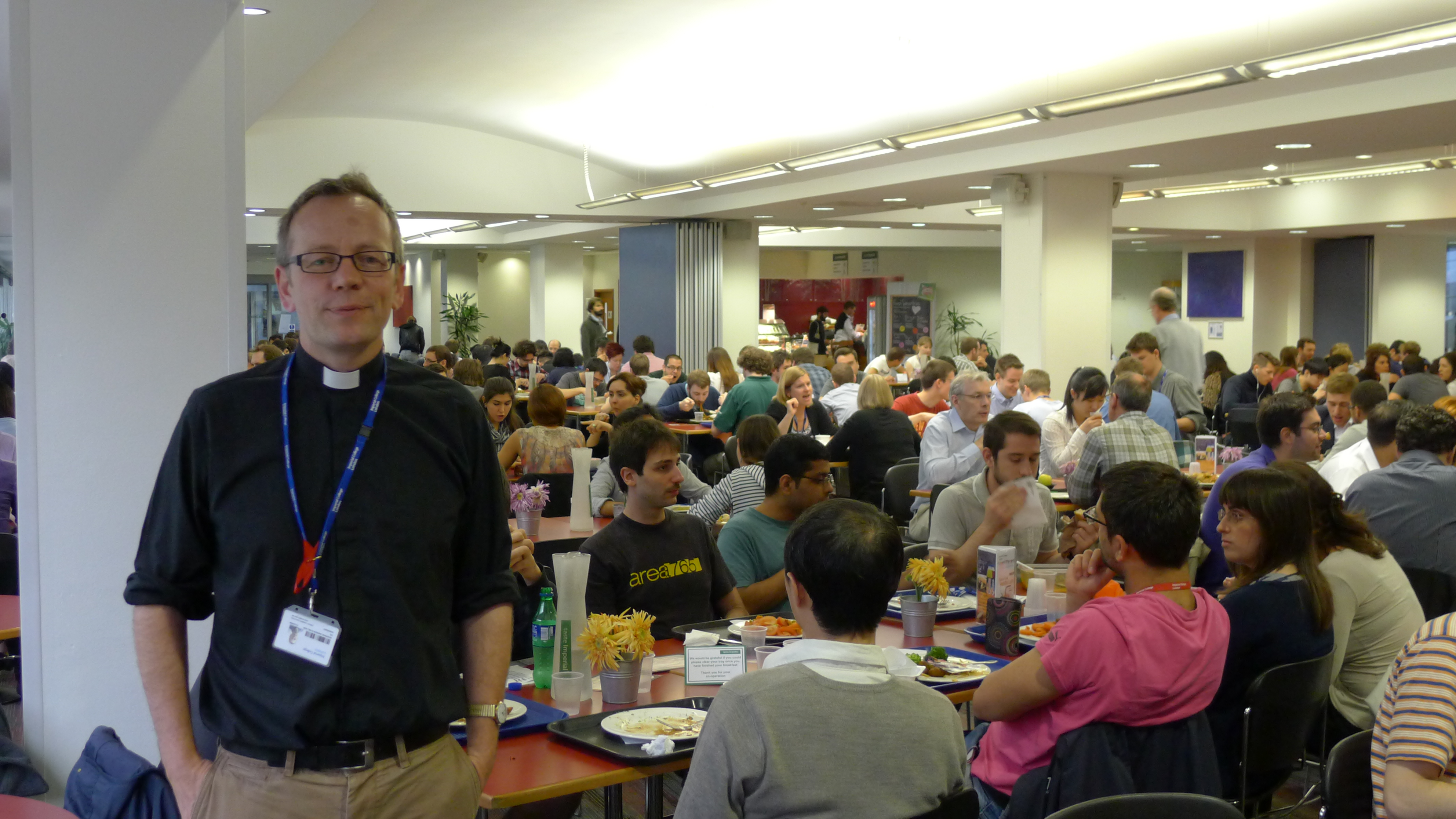
Set among various museums in London, like the Science Museum, the Victoria and Albert, the Natural History Museum and the Royal College of Music is the Imperial College of London. There I met the  chaplain, Andrew Wilson for lunch today. We joined the throng in the staff and postgraduate cafeteria. Nearly 50% of these students come from overseas, undertaking research in applied sciences and technical applications to mathematics, in fields such as engineering and aerospace.

But on the way to meet Andrew, I noticed an art exhibition in the huge glassed-in foyer – artistic responses to fields of mathematical and applied mathematical theory.
www.facebook.com/Artifact.IC
I remembered Erica Jolly’s book “Challenging the Divide” which is a plea for inter-disciplinary engagement between the arts and the sciences. I picked up a copy of the catalogue for the exhibition to give to her when I return home.

Andrew and I have been connecting at university chaplaincy conferences for a few years now. It is wondrous that on different sides of the globe we find ourselves on such similar paths,  exploring chaplaincy practice informed by the theme of hospitality and responding positively to the number of international students of various faiths, supporting them at this special time in their lives.

Andrew is yet another chaplain who is venturing into this seemingly new domain, common the the MoTiv chaplains, and also the domain of the Nokia project manager. Put simply, it seems to involve a sensitivity to know when one is a guest and when one is a host – and how to be a good guest and a good host.

We had a great time of sharing and affirmation. No doubt we will keep in touch and swap notes when we meet again.

Guest and Host

P1020261

I have spent this week in retreat in what some might call a Motherhouse, but here in outer South-west Berlin, they call it a Heimart Haus – a home. Think of four stories, including basement, the size of the old Goodwood Orphanage – quite a home! These are places where, in days gone by, single women lived together in a ‘sisterhood’ of support. Many were nurses. They live lives caring for others, the story of the Good Samaritan being their guide. Florence Nightingale was said to have been influenced by them.

Sandy and I are living in a refurbished  second floor room while she attends meetings of the World Diaconate. The photo shows some of these Deacons – from Germany, Switzerland, Finland and Sweden, England and Africa. I am using the week for writing and reflection.

Today I had a conversation about the church and the state with a deacon. One of her comments was that the church had to learn to be a guest in the world, to overcome its tendency to want to push itself on to others. I thought this was relevant to our thinking about hospitality.

So I wonder what qualities and behaviours make a good guest? And how might they be any different to being a good host?


June 28, The Steps of Motive – two stories

P1020263P1020265

Fear of the Unknown
1982, Faculty of Civil Engineering

A hallway in a building of armoured concrete. A building that, in all of its peace and quiet, is evidence of the strength and value of this material. This is the building for civil engineering in Delft. Sunlight pours through the windows and displays the construction at its best. A sign on the rough concrete wall proudly states how many kilos each square metre floor can bear.

In the hallway, there is an oak bench. On it sits Ton Meijknecht, alone. Ton is a pastor, appointed by the Bishop of Rotterdam to aid these students. He has become aware of the fact that his position has become untenable. He has been here for a few years now. It is 1982, and he has worked in this profession since 1975. Initially, everything was still very traditional. Students were drawn to his conversational groups because with him, they found what they had found in their parents’ church: a sense of direction in their life. The old pillar was still erect, if only just. Students still had faith in him as an official. But that soon deteriorated. Every year, the interest waned. Each year, he made an even greater effort, with even fancier brochures and catchy titles. To no avail; he is, and will always remain, an outsider.

He waits. It is a bench just outside the office of the Study Association, Practical Study. Inside, the Board has a meeting on a proposal. Two civil engineering students, with whom he has put a proposal together, are in there as well, pleading. Will the Board be willing to accept the proposal?

The proposal is a rather unusual one. In this building, tangible things like concrete and steel are usually highest on the agenda. Here, it is about the power of the water and the strength of the ground. The world is a rational place. In the end, you can calculate anything and everything. Maybe not now, not yet, but ultimately you will be able to. The study association works in this spirit. In a playful manner, students learn the game of the elders. They are busy with students’ interests where their studies are concerned, with internships and excursions with potential employers and with typical student pranks, such as stealing the totem pole of a rival association.

The proposal they are now discussing is new. Will the association cooperate with the plan to make professors talk with the students about their choices? The proposal is: ‘look at your choices from the beginning of a career, from the middle of a career, and from the end of a career’. What do you expect at the beginning of your life as an engineer, and what has come of that at the end? Or, what kind of career would you like to look back on? Why do I do this work or the studies educating me to do this work?

Students adopt the proposal, and a new activity is born. The concept is simple. The professor shares his experiences with the students. Students do not expect him to have any doubts. After all, he made it! How strange it is to discover that this man acknowledges that he is becoming increasingly doubtful as he gets older. Not where his calculations are concerned; he masters that part of his profession. But he does doubt the usefulness of his designs, the political game surrounding them, or worries about the corruption in the building world. This has a deep impact on young people, hearing those things from someone of experience and distinction. It impresses them, more than the words of any pastor could.

*********************************

MoTiv - Version 2

Discovery in the night
1997.Campus of Delft Institute of Technology

Night has fallen on the Delft campus. The buildings look deserted in the dark. At this hour, no-one is at work in the labs anymore. The library is closed. Only the street lights are on. It is well past midnight. Through the night rides Renske Oldenboom on her bicycle.  She is on her way home, after a long and intensive conversation with a group of architecture students. She does not know exactly what time it is. It is late. But it was worth the effort. She goes home with a feeling of contentment.

This was ‘The Night of the Philosophy’. It was an initiative by students in architecture. They had come up with this plan out of dissatisfaction with the one-sided communication at their faculty. The distance between students and professors is enormous, most education is one way traffic. The master speaks, while the pupil listens. He sometimes speaks in wonderful images, but he is the only one allowed to speak. The others have no role, other than listening. Students felt the need for a more equal and personal conversation.

In the ‘Night of the Philosophy’, the wish for another form of communication found its way. No arrangement like that of a lecture room, with the standard division of roles, but a number of adjacent round tables. At each table, ten students and a renowned architect are seated. There is no set subordination within this format. Each student talks from his or her own anger and dreams. The great man at the round table suddenly turns out to be a human being with his own anger, and dreams of his own as well. A little further ahead in his career, but at his level, clearly occupied with the same questions. What a relief. Students are having a great time.

The idea had stemmed from a meeting of a group of students with an architectural critic. Renske Oldenboom had ended up in this flow. With pleasure, with her own approval, but still, she was overcome by it. On her bicycle on her way home, she tries to think of what was so fascinating about this night, that it kept her up this late. The feeling is good. But how reliable is that feeling?

Coming from a church community, the work among students is a new challenge. When a spot became available in Delft for a Protestant student pastor, and a friend drew her attention to that, she saw it as the opportunity she had been waiting for.

She comes into contact with a group of students in architecture. With them, she feels at home, but at the same time, she senses her limitations. Her skills as a church pastor abandon her. Then, her role was still clearly defined by the tradition and the expectations of the people in her congregation. These students expect something from her as well. What that something is, they could not say. There were clear signs of their appreciation, but that was it. The rest is up to her.

That is what she was doing that night on her bicycle. Figuring out what her role was. Within the group, she has started with something practical and had begun to pour the coffee. Her intuition told her that she had to become part of the group and had to start operating in an ‘embedded’ way. She was no ordinary member. She was clearly older, but could not have been their mother yet, and that wasn’t necessary either. So what was her identity, the strength that would satisfy the other person as well as herself? Not a pastor, like in her old work. No second mother, no fellow student, no famous architecture connoisseur.

Slowly it is beginning to dawn. A light shines in the night. She finds a new role. She discovers that she stands for intimacy and confidentiality in the conversations. Because of her, famous people can show their vulnerability. Students overcome their fear to speak freely. Students, professors and professionals meet at a personal level. They share their doubts, insights, worries and inspiration with each other. She has discovered her new identity: the pastor has become a coach and has at the same time remained a pastor. She is greatly enthused by the idea.

********************************

These two stories, illustrating aspects of the philosophy and practice of MoTiv – technology and spirituality in Delft, are taken from the booklet The Steps of MoTiv – chaplaincy as discourse of disclosure, June 2012. They contribute to the discussion about Faith in the Public Sphere.

June 26

FRI SAT SUN 1 FRI SAT SUN 2FriSatSun PLAN4

Last week we had a meal in London with our friends from 1974, Meryl and Malcolm Doney. Meryl is an art curator and Malcolm is editor of the special features pages of the weekly Anglican newspaper. They have also been on the Board of Greenbelt Arts Festival for as long as we’ve known them.

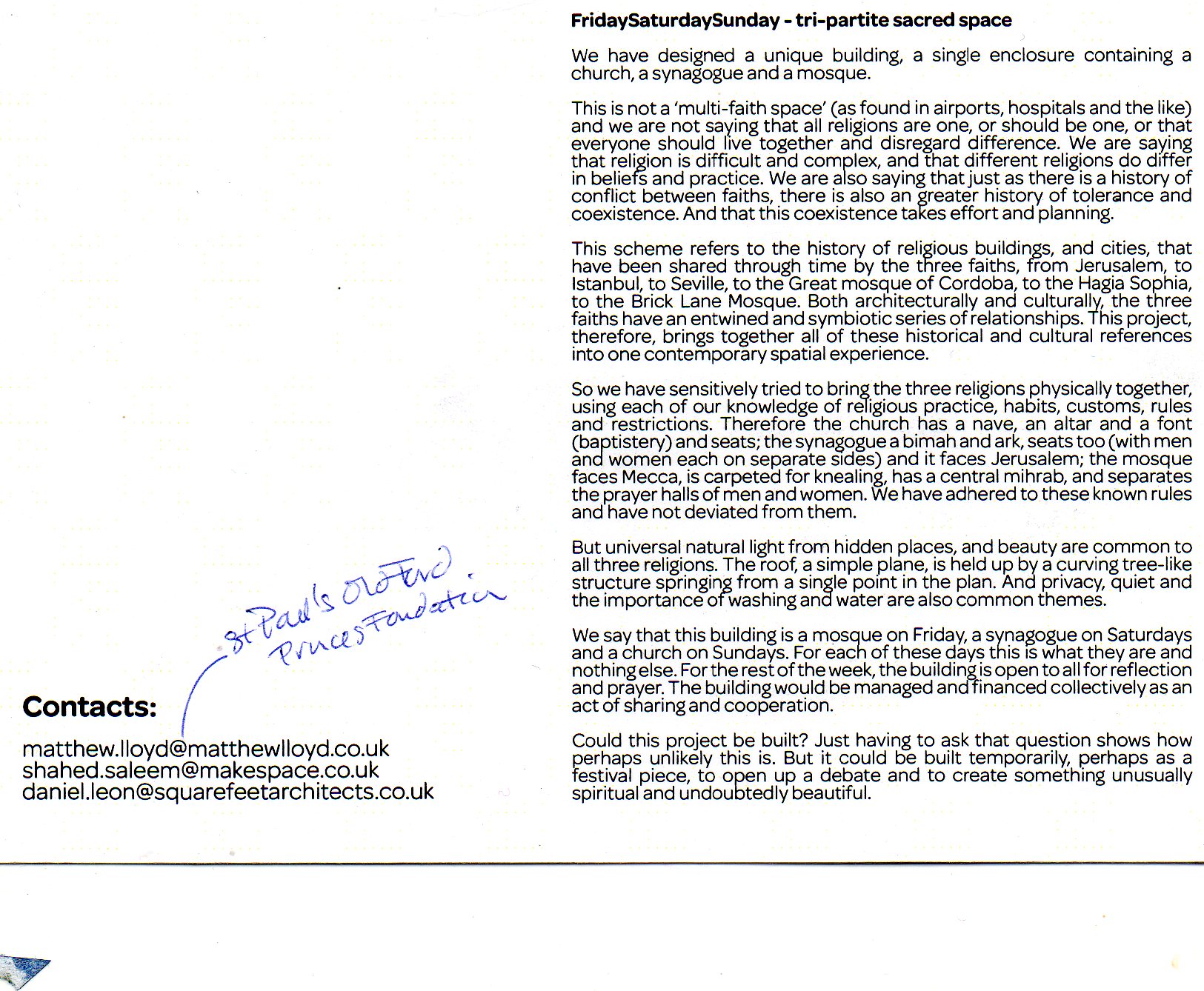
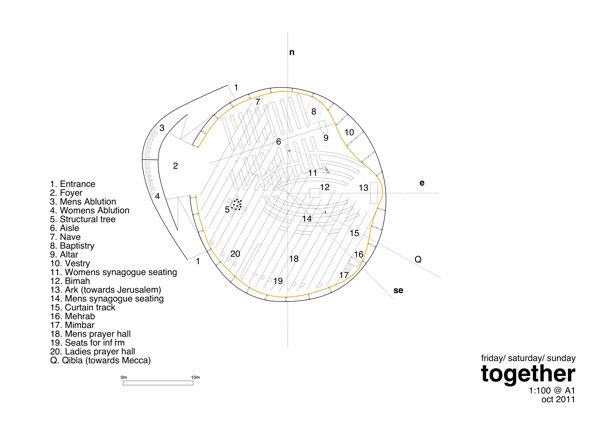
Our conversation turned to architecture and Meryl pulled out her laptop to show us this conceptual piece, “Friday, Saturday, Sunday – Together”.

“You can find more on the websites of the three architects. I think we are going to feature them at next year’s Greenbelt.”

June 24, A Nokia Conversation

IMG_0848

Last night we went to dinner to catch up with friends of our son Nick. They are both working with Nokia in Berlin.

During the evening Kevin and I got into conversation about our respective work. He is in middle management overseeing a number of Nokia project teams. As he went on describing what he does, I was struck by how similar his work is with mine. He likened his position to being horizontal and facilitating a number of vertical projects – or rather, facilitating the people involved in these projects – being ‘across’ it. He says it takes a lot of listening. When he perceives any blockage he takes that person out for lunch or a coffee and listens to them. He offers any help if that is asked for. He doesn’t want to construct any ‘glass ceiling’ but really wants everyone to be turned on to doing their best. He described his role as very complex and nuanced. How he may speak in one context may be different to another, depending on what needs to be done or said to serve the best interests of the other –  a service model. More often than not, it is a listening and discerning process. He immediately made the connection that in my role as coordinating chaplain, he supposed that I work across the diversity of faiths, encouraging each to be the best they can be by listening to the leadership of each to facilitate their development. I’ve never before had anyone actually ‘get’ (comprehend the subtleties of) my job in five minutes!

I asked him how this part of the company fits into the overall Nokia management structure. Again, I was struck with similarities. The top level of Nokia have decided on an overall purpose and culture. This is transmitted to each of the Nokia development areas – phones, I.T. etc. So the various parts of the company all know the direction they are going; interconnections can also be made within this common purpose and culture. I take this to be like our University’s Strategic Plan that tells us what kind of university we want to be and how we intend to get there. The key to the Nokia culture is communication so that accountability to business goals is part of the process. Although there are goals, it is wonderfully open-ended and vision-driven; failure can be as important to growth as success.

I went away remembering conversations with Onno, the App developer, in whose flat I stayed in Delft, and with my sons’ Nick and Andrew in the way they approach their work. In all cases, having a university degree had little to do with what they have learnt, to be where they are in their fields. In Kevin’s case, he resisted all my attempts to have him name management books so I could get some short cuts. All he had learnt, he had learnt on the job, mentored by a good manager – learning by doing – praxis.

June 23

P1020217  P1020211 P1020232 P1020236 P1020241

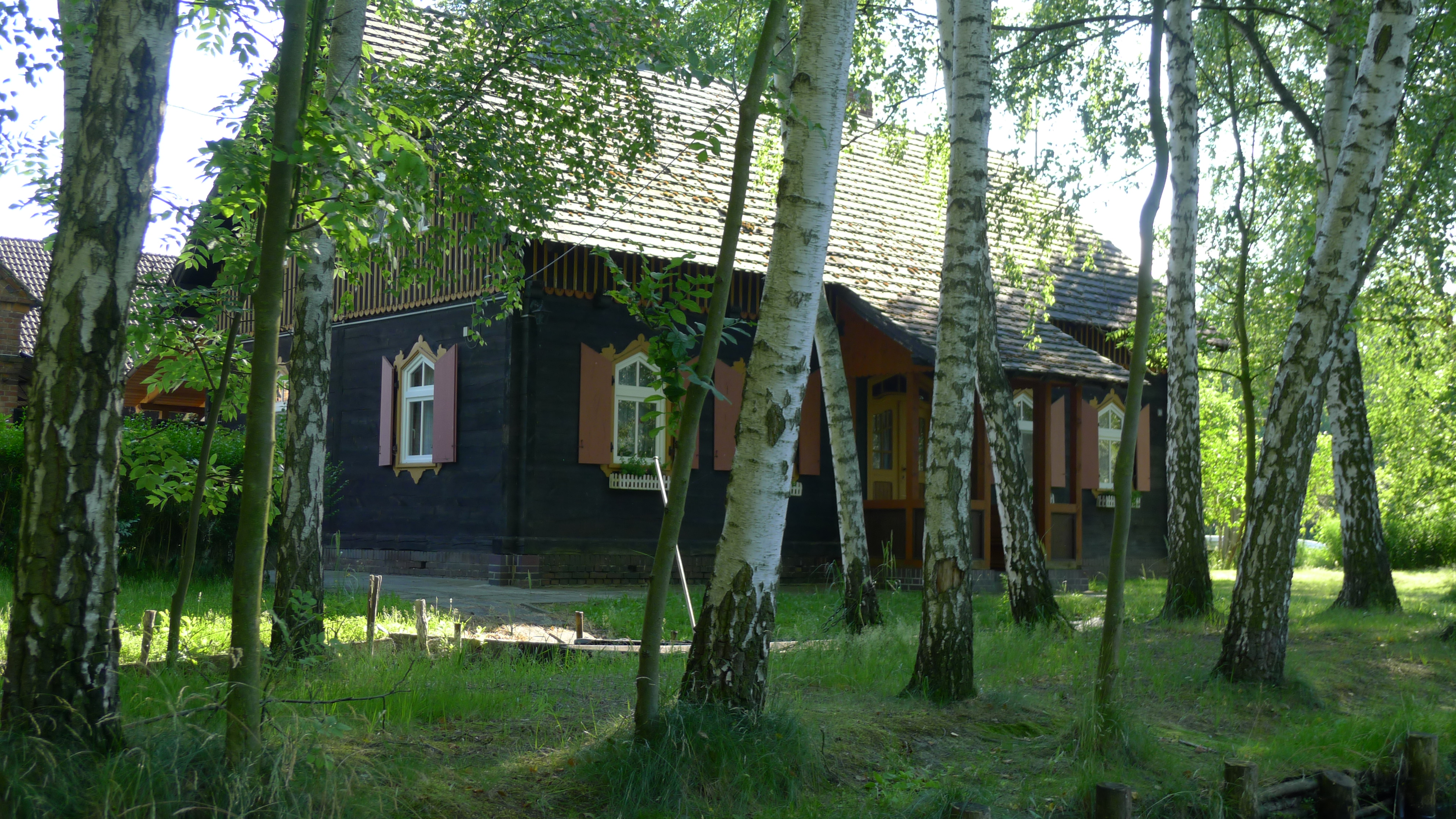
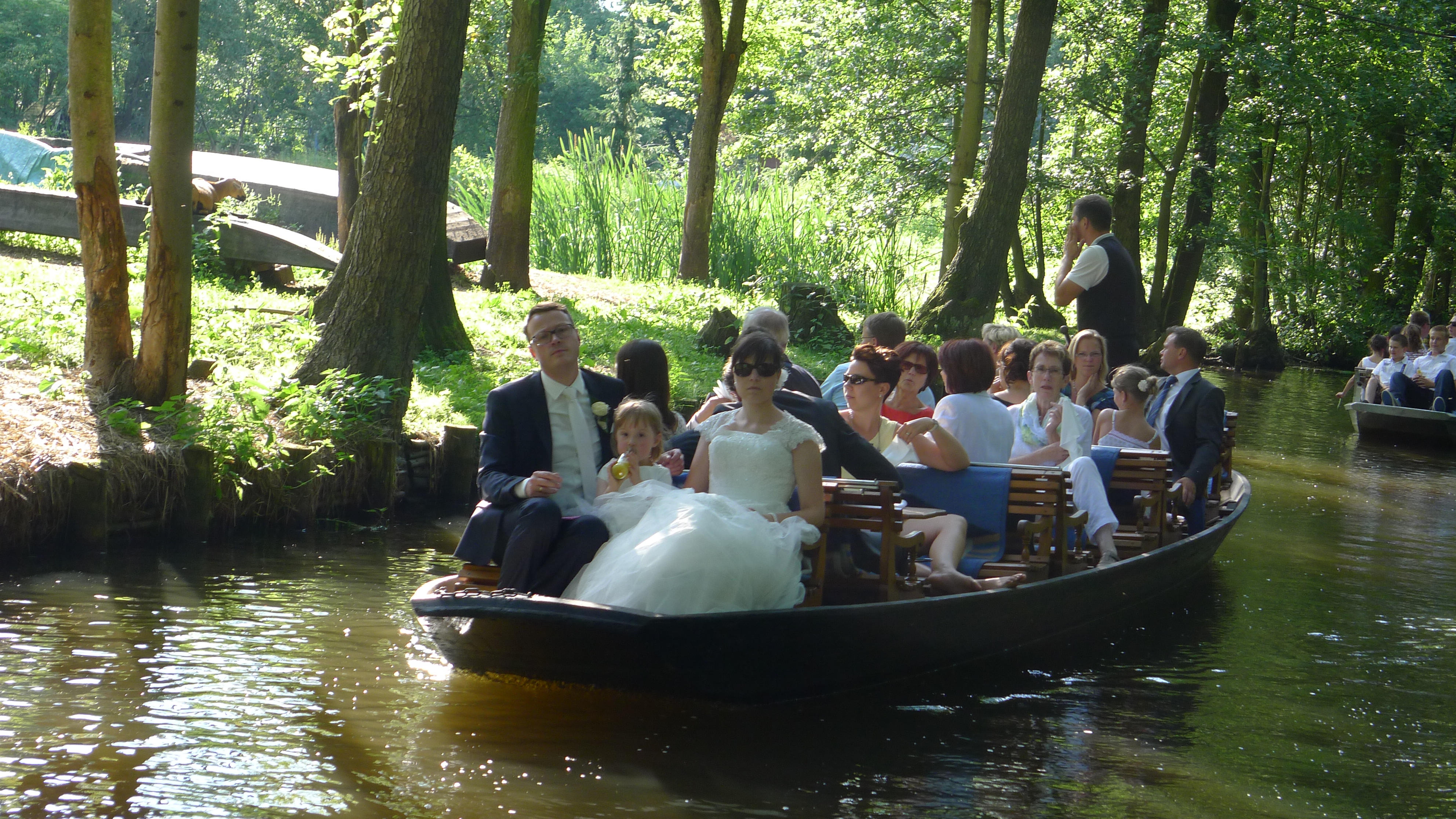
Today we took a one hour train to Lubbenau Spreewald to meet up with Joanna and her baby Sienna. Joanna couch-surfed at our place, three different times in her year backpacking around Australia  two years ago. And we became good friends.

She took us on a one and a half hour ride around the backwaters – a famous summer leisure activity. It was a beautiful warm summer afternoon.

Arriving back home in the evening, we had a late dinner at an Italian restaurant on Frankfurter Allee, a block away from our AirBnB on Rigaer Strasse. Asparagus and potatoes at peak season, cooked in butter with a schnitzel. Yum!


London to Berlin

Dinner with Nick and Kathy  A last meal with son Nick and Kathy in London before heading off to Berlin in the morning.

Our Berlin Street  We are stopping in East Berlin – wow, they have attitude!

Street art aboundsStreet art abounds – this is right across the road from our flat.

It is a beautiful summer evening – families are out walking and riding their bicycles along the footpaths past little outdoor eating places dotted right along the side streets. We stop at a Vietnamese place and have a light meal. It’s after nine and the light is only partially dimming – it’s always later than you think!

We like Berlin – at least this gutsy side of the city.