Author Archives: Geoff Boyce

Unknown's avatar

About Geoff Boyce

Creating and supporting opportunities for human flourishing. geoff@geoffboyce.com

Oasis and the proposed new Student Hub

What we take with us.

In 2013 we started with the idea that hospitality, understood as creating welcoming space, can be transformative. This was particularly significant in developing appreciative, respectful interfaith relationships among students. But we also found that such hospitality is actually a universal means of building relationships and community, providing empowering support for all  students.

Hence our Vision Statement:

Oasis is a welcoming and enabling community, open to all, contributing to personal and communal spiritual enrichment, while promoting mutual respect and appreciative understanding of diverse religious paths and cultural traditions.

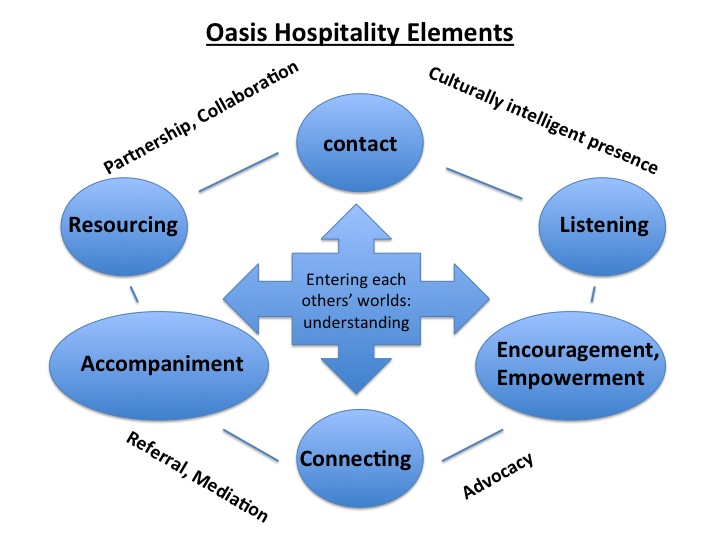
The principles of how we go about it were summed up in the Oasis Hospitality Elements flowchart:
Oasis Hospitality Elements

What does Oasis do for students? It hosts.
What does Oasis do for the University? It collaborates.
What does Oasis do for the wider community? It tells its story, it demonstrates with participatory workshops and it conducts rituals and ceremonies by request.

Potential benefits include:
# making links & connections
# liaisons, cooperation, collaborations
# providing support, cohesion, continuity
# company, companionship, friendship, mutuality
# getting to know ‘others’, understanding, mutual acceptance
# developing cultural and emotional intelligence

We have every indication that the underlying strategy of Oasis has been successful, as students have encountered the unconditional welcome of Oasis. Recognition of success led to the creation of Oasis Ambassadors. Those transformed by the Oasis experience now give impetus to a vision for what might be achieved in the longer term – student leadership across the world committed to the practice and principles of hospitality, learnt informally at Oasis.

Accordingly, I believe we are now at the stage when we might recognise that Oasis is a centre engaged in informal learning.

How might this role of Oasis be extended in the proposed new Student Hub?

Recognition of the significance of informal, extra-curricular learning might take Oasis to a new level in the proposed new Student Hub.  However, the University must first recognise and value the significant place of informal learning as complementary to the formal learning process.

The edited video below makes a case for valuing informal learning for the 21st Century student. The points I have highlighted in the video suggest how the Oasis paradigm might be extended to provide safe, sanctioned ‘home’ environments that foster informal learning, extending the successes we have achieved over the last 12 months.

I am suggesting that Oasis, through its practice of hospitality, might provide an empowering ‘home’ environment for informal learning that may go beyond discussion and conversation to creative activity such as digital media, art, music and radio – spaces that provide connection, communication, collaboration and creation.

What else?

Because Oasis also engages with the wider community, access to its spaces in the proposed new Student Hub is a significant consideration – proximate parking and proximate loading.

External spaces linked to the internal spaces of the proposed Student Hub are significant for some cultues and religions.

I hope that consideration be given to externally linking Yunggorendi with Oasis to provide outdoor teaching space for Yunggorendi, native vegetation and an outdoor sacred ceremony site, which gives an unobstructed view to the western (sea) horizon. Consideration might also be given to a memorial site within this development.

Consideration might also be given to a western-facing balcony area linked with Oasis.

It is important that wherever possible, Oasis spaces have windows that look out to the western sea horizon or on to Flinders’ wonderful natural habitat.

 

“Empowerment Volunteering”

I think I may have invented a new bit of jargon for the literature – ‘Empowerment Volunteering’! Here is how it came about…

Rajeev was attending a morning tea in Oasis convened by the International Student Services Unit to give international students an opportunity to socialise.

Afterwards Lisa, our Oasis Administrative Officer, introduced him to me and told me that he wanted to volunteer in Oasis.

We sat down in a quiet room to talk about this. Rajeev is a ‘mature age student’, a paediatrician from the UK. He is concerned about health and poverty. He had saved up $60,000 in the UK to come to Australia to undertake a Masters course in health sciences – Flinders is, according to him, the only university in Australia that awards a Masters degree in Public Health with an international development component. He wants to gain a position in either of the World Health Organisation or a United Nations body like UNICEF, so that he can make a better contribution by directing resources to where he believes there are most needed.

I asked him about his religious convictions, which by his conversation,seemed to be driving his altruism. He is Hindu.

We had a brief conversation about the his beliefs, and from the light in his eyes, I could tell his Hindu faith was the source of his life and of his his quest. I sensed this might be the start of a wonderful friendship.

As he shared his life with me, I could not think of any obvious Oasis project he might slot into. So finally, I suggested that he merely drop-in for a cup of tea when he had a spare moment and begin to make himself at home in Oasis, listening to fellow students, who also come in to relax and enjoy each other’s company. In that way way, I thought, by the process of listening, some project or engagement might suggest itself to him – some idea that might derive from within his own being in response to these conversations.  Or, he might find that hospitality is of itself, a significant contribution to others, as I have.

He was quick to understand what I was suggesting.

As I considered this later, I thought that what I had stumbled on was a different way in which volunteering can be nurtured. Not the slotting in of appropriate persons into pre-established projects, but allowing what is within a person to take shape in response to and interacting with their environment in the context of a hospitable community.

We shall see how it works out. But I have a feeling that by trusting a patient, open process, the outcome will be life-giving and significant.

In the meantime I am boldly naming a new method re the formation of volunteers – ‘Empowerment Volunteering’!

Finding Common Ground

A heading in an email digest I received today from The Chronicle of Higher Education caught my eye.

Campuses Focus More on Meeting International Students’ Needs.

With more foreign students on American campuses, the conversation is shifting from recruitment strategies to practices that help them succeed.

Retention is becoming the name of the game.

This week I attended a staff seminar, Graduating Global Citizens in Science & Engineering, exploring the results of a research project initiated by Melbourne University’s Centre for the Study of Higher Education, ‘Finding Common Ground – enhancing interaction between domestic and international students’

Feedback from international students indicates that although they rate the courses they have undertaken in Australia highly, the one thing that they regretted was that they had not made lasting friendships with local students. Clearly, international students choosing to study in Australia hope that an important side benefit of their international experience will be an engagement with Australian culture, and friendship with locals in particular.

One thing from this seminar really stood out for me.

We know anecdotally that local students and international students do not tend to engage outside the classroom. Local students already have their own circle of friends. ‘Finding Common Ground’ suggests that cross-cultural engagement must take place in the classroom.

This has big implications for university teaching – now the teacher must not only be culturally intelligent, but value and structure for cross-cultural engagement within his or her curriculum and teaching practice.

Some Flinders teachers shared their practice.

Associate Prof. Kenneth Pope from the School of Computer Science, Engineering and Mathematics told how one of the subjects he teaches is tied into Engineers Without Borders, an international organization that undertakes practical projects in developing countries. So  inter-cultural issues and cross-cultural experiences are actually embedded within the Flinders course itself.

Dr Ingo Koeper, Senior Lecturer in the School  Chemical and Physical Sciences, told of a weekly two hour discussion session he set up for a small group of postgraduate students from diverse backgrounds. While the students may have expected the session to have focussed on improving their understanding of course content, as the teacher, he had put this to one side and encouraged the students to talk about themselves. Only when content issues were raised by the students themselves did he go there. The main thing was for the students to interact with each other.

This is hospitality, as we understand it in Oasis, in the classroom!

Oasis and the Wider Community

Today Kylie Davis, our Pagan Chaplain articulated what I think is an excellent framework to help us work through how Oasis might initially respond to requests from the wider community.

The principles are:

  • Telling: members of the Oasis Team share their experiences about being involved in Oasis in the context of the expressed needs of the audience.
    Eg the Oasis Team have shared their experiences at national and local conferences of chaplains interested in interfaith relations.
  • Hosting: workshops hosted by Oasis involving active participation by the participants on the themes of interfaith ceremonies, celebrations and rituals and how they may be constructed inclusively.
  • Doing: create and enact a public ritual in which people participate. A learning experience and a resource for future use, development or adaption.
    Eg the Multifaith Australia Day Celebration, Opening rituals of Oasis Celebrations at Flinders.

These principles expand on the existing practice of Oasis, as an encouraging host to individuals or groups who may want to use the Oasis Facilities, in keeping with the ethos of Oasis. In this way the mission of Oasis is multiplied by others.

Hospitality Skills Development

In my book ‘An Improbable Feast’ I explored how hospitality became the unifying and informing practice of Oasis.

An understanding of hospitality informs every aspect of the relationship of Oasis with the University, the wider community, the use of the Oasis itself as a centre, how conversations and relationships are initiated by members of the Oasis team with students and staff, and also within the team itself, and how discernment is exercised among those seeking support at Oasis.

Oasis fosters health and well-being by informal, social means through the practice of hospitality, complementing the University’s Health and Counselling Service which fosters health and well-being by formal means through the practice of therapeutic intervention.

In the development of Oasis this year, the Oasis team has identified elements within the process of offering hospitality.
https://travellingchaplain.com/resources/

Now the question arises, how might the skills needed to accomplish each of these elements be developed and sharpened?

I suggest for discussion:

1. The motivation and attitude of the team member
The voluntary nature of the Oasis enterprise assures that team members are more likely than not to be motivated toward contributing to the achievement of the vision of Oasis in an attitude of service. However, the question of whose needs are being met and how, requires constant interrogation.

2. Information and practice
The directions and fortunes of the university contextualize Oasis.
Fundamental changes challenge the whole university enterprise. For example: http://www.abc.net.au/radionational/programs/ockhamsrazor/the-changing-face-of-university-education/5011596#transcript

If the prophet above is anywhere near the mark, and I suspect he is, and universities become less and less places people go to get information in order to buy credentials for employment then the role of an Oasis on campus becomes called into question; and credentialing pastoral care through traditional processes may also need to be reconsidered within this conversation.

It would be possible, for example, for Oasis to create a MOOC in pastoral care aimed at a national constituency in the first instance, to provide information and quizzes that generate cognitive understanding. Responsive learning, through conversation, might take place face-to-face in regional centres, and those with the wisdom go to them to provide foci for encouragement and practice. These encounters might create small communities of ongoing reflective learning and support.
The role of credentialing might become the concern of professional bodies in partnership with MOOC providers and the institutions and employers in which such credentialed persons operate.

The Interfaith Role of Oasis

Oasis is a welcoming and enabling community, open to all, contributing to personal and communal spiritual enrichment while promoting mutual respect and appreciative understanding of diverse religious paths and cultural traditions.

Oasis as an Interfaith Centre

The mission of Oasis is to enact and promote the practice of radical hospitality.

Radical hospitality may be described as making space – in which we enter respectfully into each other’s worlds in order to understand appreciatively, whether that space for the other be physical, social, emotional, religious or intellectual.

For members of the Oasis team, radical hospitality is intentionally for the benefit of the other, rather than for the satisfaction of one’s own needs.

Hospitality… means primarily the creation of a free space where the stranger can enter and become a friend instead of an enemy. Hospitality is not to change people, but to offer them space where change can take place. It is not to bring men and women over to our side, but to offer freedom not disturbed by dividing lines. It is not to lead our neighbour into a corner where there are no alternatives left, but to open a wide spectrum of options for choice and commitment. It is not an educated intimidation with good books, good stories and good works, but the liberation of fearful hearts so that words can find roots and bear ample fruit. It is not a method of making our God and our way into the criteria of happiness, but the opportunity to others to find their God and their way. The paradox of hospitality is that it wants to create emptiness, but a friendly emptiness where strangers can enter and discover themselves as created free; free to sing their own songs, speak their own languages, dance their own dances; free also to leave and follow their own vocations. Hospitality is not a subtle invitation to adopt a life style of the host, but the gift of a chance for the guest to find their own.

(Henri Nouwen. Reaching Out: The Three Movements in the Spiritual Life. 1975 Doubleday. New York. p 68)

Interfaith Hospitality

In its practice of interfaith hospitality, Oasis enacts and promotes the principles of:

1. The Faith Friendly Communities Charter:

Principle of Mutual Recognition

A faith friendly community recognises the right of all faiths to meet the needs of their respective members in any given community.

Principle of Mutual Concern

A faith friendly community intends to meet the religious and spiritual needs of its members of various faiths.

Principle of Mutual Understanding

A faith friendly community seeks to understand the values and beliefs of each faith in a given community rather than to pass judgement on them.

Principle of Mutual Respect

A faith friendly community seeks to respect the differences between the values and beliefs of its members.

2. Four basic principles of interfaith dialogue identified by Churches Together in Britain and Ireland (formerly the British Council of Churches):

Dialogue begins when people meet people
Dialogue depends upon removing misunderstanding and building up trust
Dialogue leads to common service within the community
Dialogue is a means of authentic witness


Oasis as an Interfaith Centre

The mission of Oasis is to enact and promote the practice of radical hospitality.

Radical hospitality may be described as making space – in which we enter each other’s worlds in order to understand appreciatively, whether that space for the other be physical, social, emotional, religious or intellectual.

For members of the Oasis team, radical hospitality is intentionally for the benefit of the other, rather than for the satisfaction of one’s own needs.

Hospitality… means primarily the creation of a free space where the stranger can enter and become a friend instead of an enemy. Hospitality is not to change people, but to offer them space where change can take place. It is not to bring men and women over to our side, but to offer freedom not disturbed by dividing lines. It is not to lead our neighbour into a corner where there are no alternatives left, but to open a wide spectrum of options for choice and commitment. It is not an educated intimidation with good books, good stories and good works, but the liberation of fearful hearts so that words can find roots and bear ample fruit. It is not a method of making our God and our way into the criteria of happiness, but the opportunity to others to find their God and their way. The paradox of hospitality is that it wants to create emptiness, but a friendly emptiness where strangers can enter and discover themselves as created free; free to sing their own songs, speak their own languages, dance their own dances; free also to leave and follow their own vocations. Hospitality is not a subtle invitation to adopt a life style of the host, but the gift of a chance for the guest to find their own.

(Henri Nouwen. Reaching Out: The Three Movements in the Spiritual Life. 1975 Doubleday. New York. p 68)

Interfaith Hospitality

In its practice of interfaith hospitality, Oasis enacts and promotes the principles of:

1. The Faith Friendly Communities Charter:

  • Principle of Mutual Recognition
    A faith friendly community recognises the right of all faiths to meet the needs of their respective members in any given community.
  • Principle of Mutual Concern
    A faith friendly community intends to meet the religious and spiritual needs of its members of various faiths.
  • Principle of Mutual Understanding
    A faith friendly community seeks to understand the values and beliefs of each faith in a given community rather than to pass judgement on them.
  • Principle of Mutual Respect
    A faith friendly community seeks to respect the differences between the values and beliefs of its members.

2. Four basic principles of interfaith dialogue identified by Churches Together in Britain and Ireland (formerly the British Council of Churches):

  • Dialogue begins when people meet people
  • Dialogue depends upon removing misunderstanding and building up trust
  • Dialogue leads to common service within the community
  • Dialogue is a means of authentic witness


Further amendments

Suggestions for amendments I think worth adopting.

Beatrice Panne, lecturer in Pastoral Care at the Uniting College, has suggested adding a piece to our Elements of Hospitality schema – ‘entering each others’ worlds: understanding‘ – thanks Beatrice!

Oasis Hospitality Elements
And the word ‘appreciative’ has been added to our vision statement:

Oasis is a welcoming and enabling community, open to all, contributing to personal and communal spiritual enrichment, while promoting mutual respect and appreciative understanding of diverse religious paths and cultural traditions.

Five Months On – Evolving Directions of Oasis

Five months on from Oasis being incorporated and resourced by the University:

who we think we are:

Oasis is a welcoming and enabling community, open to all, contributing to personal and communal spiritual enrichment while promoting mutual respect and understanding of diverse religious paths and cultural traditions.

and in a nutshell (but maybe a bit of a mouthful!):

Oasis – community and spirituality through hospitality.

* We have defined an Oasis Team – an inner core of the Oasis community who:

    • want to contribute to realising the Oasis vision,
    • are volunteers, working within the codes of practice of Volunteering Australia,
    • want to develop new skills and understandings that enhance the quality of their  service.


“Oasis is a welcoming… community…”

* we have identified elements we think combine to enact the “welcoming” Oasis offers:

Oasis Elements

* these elements are helping us identify some of our skill development needs

“Oasis is… an enabling community…” 

* In the university and wider community we seek to enable by forming partnerships and collaborations, asking the question: ‘What do you need from Oasis?’

* We are replacing ‘meetings’ with meals, fostering the Oasis Hospitality Elements.

Refinement

Oasis Elements

Following discussion of the schema we came up with – “Oasis Hospitality Cycle” – posted previously, I am proposing the following refinement.

The commentary on each of the elements still stands.

Chaplaincy in the Secular God/Spiritual World

A particular model I call ‘traditional chaplaincy’ is deeply ingrained in the consciousness of the church. Such a deep and resistant image continues to dominate the church’s understanding of chaplaincy, influenced by the weight of history. ‘Traditional chaplains’ are agents of the church ministering to adherents who are geographically removed from parish life, and in particular, administering the sacraments to those who, through life’s circumstances, are displaced from their local church.

 Such chaplains have typically been ordained clergy who go about the business of parish life outside the parish – conducting worship, ministering the sacraments, educating, providing pastoral support and being the focus of the Christian community life of adherents distant from the parish. Traditionally, chaplains were appointed to institutions such as armies and prisons and hospitals.

‘Traditional chaplaincy’ has suited the purposes of the church over millennia – to ensure a presence in society’s major institutions, to do the church’s business there and to convey and strengthen the influence of the church. This is a model of chaplaincy that is about cultural transmission of parochial life. And it is probably the default understanding of chaplaincy among most church people.

In our current context, such a model is of no import to the institution itself save what the institution or a smarter chaplain may make of it. Traditional chaplaincy is marginalized from the real life of the institution and the institution has no interest in supporting what churches may or may not do. There is a dis-connect between the churches and the institution.

So today, chaplains who hope to survive the decline and irrelevance of the church are adapting to this marginalization. There is a movement by chaplains to provide pastoral care in a secular way. Institutions are rewarding this inclusive approach. Such chaplains have given up on the traditional model. They minister without condition (not just to their adherents) and they articulate their role in terms of the ‘spiritual’ rather than the religious. The ‘spiritual’ has become the purvue of the chaplain, while the parish minister is inevitably dispensing ‘religion’ – that is, upholding those practices important to the culture of the church.

The parish minister is protected from the disconnect between the church and the world because the focus of the church and the seat of power of the church is founded in the parochial – the effort to continue parish life.

The theological insights of the Dutch Catholic theologian Erik Borgman shine a light on our modern dilemma – the irrelevance of the church and its message, from the perspective of the world.

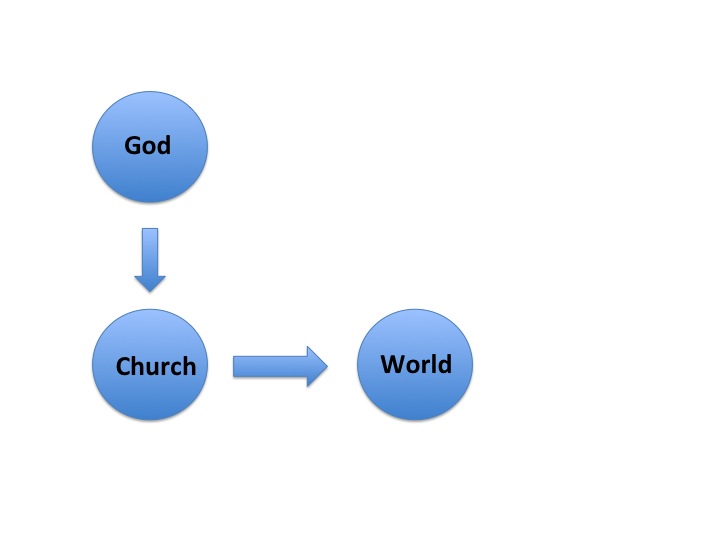
Traditional church consciousness
Fig. 1 Traditional church consciousness

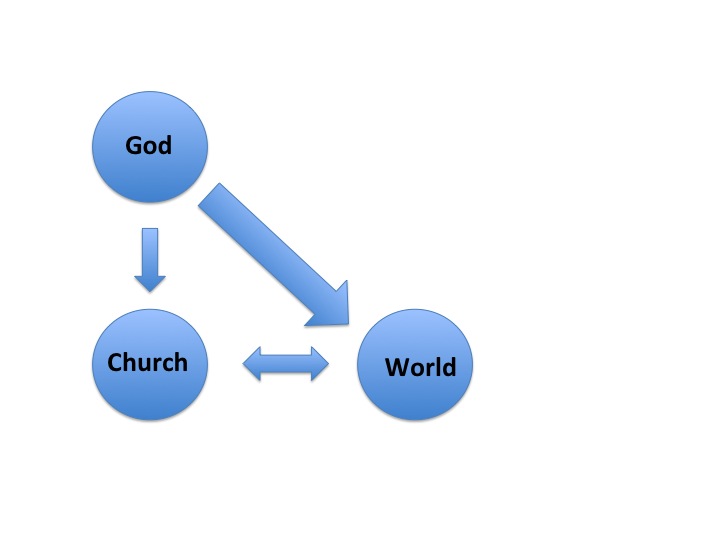
Borgman suggests that the typical consciousness of the church assumes that the world is god-less and in need of salvation. The world is the domain of sin. The church mediates the means of salvation between God and the world. God has revealed the means of salvation to the church. Chaplains within this paradigm are the church’s representatives bringing the good news of salvation to ‘unsaved’ people in the world, or pastoring the church’s adherents in the world.

The church is discovering that the world is not interested in the church’s ‘answers’ and finds such a paternalistic approach offensive. The church, if it is listening at all to feedback from the ‘World’, is being given the message that the World’s people (at least in the West) are “spiritual, but not religious”. Commitment to institutional religion has declined dramatically and continues to do so – which may be an indicator that the traditional approach, based on the assumptions underlying figure 1. is failing in the very mission it has assumed for itself.

Many churches are responding to this failure by ‘trying harder’.

God-in-the-world consciousness
Fig. 2 God-in-the-world consciousness

Borgman argues:

Theologically, it is the task of churches to respond to Gods salvific presence in the midst of our confusing world, not to preach their own presence as salvation from the confusing world. The pastoral task to be and stay close to people in their experiences, is based on the firm belief that it is there that God is kenotically present, as the Biblical traditions teach.

Borgman is not suggesting the traditional approach ‘in situ’ – that is a Figure 1 approach that embeds itself in the world, like a journalist in a combat unit.

The Church should not be seen as the community of those firmly convinced of the truth of their tradition, but as the community of people seeking the support of the Christian tradition to discover Gods salvific presence in the world, and to walk — and to help others to walk – the path to true life God’s presence opens.

At the heart of this God-in-the-world consciousness is the conviction that God is present and active in the world. The chaplain is therefore looking for the activity of God in the world, to cooperate and support that activity, not seeing herself as an agent of the church mediating God to the world (nor a mere agent of the institution).

This, incidentally, is perhaps why many effective chaplains, effective from the point of view of the institutions in which they work, often find participation in traditional church life so problematic and say they “don’t feel at home” there – if they attend church at all! They feel at home in the world, where they find God, and are uncomfortable in church culture.

While the church continues to assume the model of figure 1 and chaplains increasingly discover and embrace the model of figure 2 it is likely that we will see the following:

        1. the churches defunding chaplaincy because it cannot see how chaplaincy is delivering the goods according to the assumptions of figure 1.
        2. Institutions embracing a secular chaplaincy model that is inclusive and articulated in terms of spirituality.
        3. A refusal by chaplains to engage in conscious attempts at evangelization.

It may be that chaplains become prophets to the church, agents in the church’s own reformation, by helping the church examine how it has arrived at such a position of impotence.

In my view, the church should reject the assumptions of Figure 1 and its concomitant outmoded structures. It may then be in a better position to interrogate any addiction to a self-interested exercise of power and any propensity for denial in the hope of protecting itself. And may position itself for creative support of what God is doing in the world.

Reference: Borgman-Mission, www.travellingchaplain.com/resources